Junior golf doesn't stop when the course closes
Every year it happens the same way. School starts, the evenings get short, the course goes quiet, and a kid who was swinging every day in July doesn't touch a club again until April. Then spring comes and they are starting over. Not from where they finished. From scratch.
That gap is the single biggest thing holding back junior golfers who don't live somewhere warm. It is not talent and it is not coaching. It is eight months of nothing.
If you have a simulator in the garage, you already own the fix. What most people get wrong is what they do with it.
Hitting balls is not a plan
Put a kid on a launch monitor and tell them to work on their swing and you will get about eleven minutes before they are bored and asking to play something else. That is not a discipline problem. Range balls are boring for adults too, we just have the patience to grind through it because we know why we are doing it. A nine-year-old doesn't.
What a kid will do, happily, for an hour, is compete. Give them somebody to beat and they turn into a different person. That is the whole reason RISE Kids exists. I watched what happened when kids got near my sim, and it was never "can I work on my irons." It was always "can I play you."
What actually works in the off-season
A few things I would tell any parent with a sim and a kid who plays:
Keep it short. Nine holes, not eighteen. Twenty-five minutes on a school night is a win. The goal is that they want to come back tomorrow, and nothing kills that like a session that outlasts their attention.
Get the tees right. This is the one people miss. A kid playing from the same tees as you is not playing golf, they are hitting driver into a green they cannot reach and learning that golf is humiliating. RISE Kids uses US Kids Golf tiers so a seven-year-old and a thirteen-year-old each play a course that fits them.
Let them pick the course. They will pick the one with the volcano or the ocean or the weird rocks, and that is fine. A kid who chose the course is a kid who is invested in the round.
Do not coach every swing. Hardest one on the list. If you are correcting them shot to shot, you have turned their favorite thing into a lesson. Let the round be a round.
Make the number mean something. A score with nothing attached to it is trivia. A score that moves them up a board, earns them a title, or gets them one match closer to beating a rival is a reason to play again tomorrow.
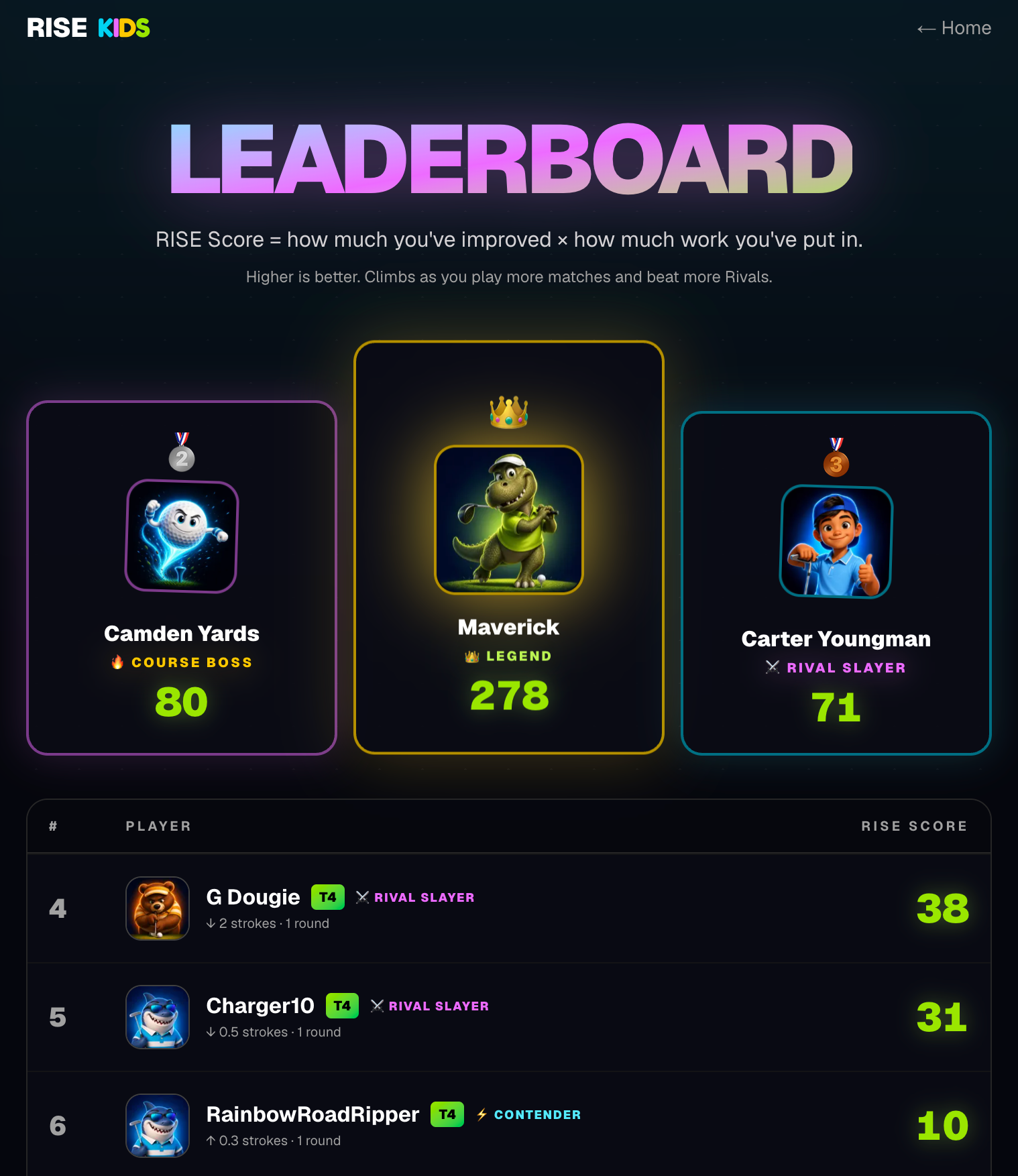
Why improvement beats talent
Here is the part I am proudest of. The RISE Kids leaderboard ranks improvement, not raw scoring. That is a deliberate choice, and in a junior context it matters enormously.
If you rank kids by score, the same kid wins every time, everyone else works out within about two weeks that they are playing for second, and they stop trying. Rank by improvement and the kid shooting 62 for nine has exactly as much to play for as the kid shooting 41. The winner is whoever got better fastest. Every kid on the board is still in it in March.
The targets move too. As a kid improves, what counts as a good round for them moves with it, so the challenge stays winnable without ever being handed to them.
Courses that work for kids
A full championship track is a slog for a young player. Some of ours that go over well:
- Magnolia Meadows Break 50 is a short executive course, everything is reachable, and the whole point is to go as low as you can. There is a course record on a sign. Kids lose their minds over that sign.
- The Sandbox Par 3 and Threetops Par 3 are quick, pretty, and every hole is a chance at a birdie.
- Island Greens and the Erin Hills Drumlin Putting Course are the ones to use when you have fifteen minutes and want it to be fun instead of a chore.
- Crater Dunes if your kid wants something that looks like a video game, which most of them do.
What you need
Not much beyond what you have. RISE Kids runs in a browser next to GSPro, so there is no extra software and no extra cost on top of a Tekbud membership. If you are still putting the room together, the golf simulator setup guide covers three complete builds and the honest version of what each one costs, and installing courses takes a couple of clicks inside the game.
Setup for a kid takes about two minutes. You make the account, you pick the tier, you enter the scores. There is no chat, no public profile, nothing they can spend money on.
Fall Showdown
The fall season starts with the school year, which means now. If your kid gets on the board before it kicks off they are part of the Founding Class, and the first titles of the season are still unclaimed.
Eight months of nothing, or eight months of climbing. Not a hard call.
Where to next
Brent Wells
Course designer · tekbud.com